Six Engineering Decisions Lock the Right Wrapper
Confectionery buyers avoid mismatching machines when they evaluate piece physics and film behavior before chasing headline PPM numbers. Part of candy wrapper sizing and selection and candy wrapping film and sealing specs, walk through these six checks sequentially.
Pay special attention to dimensional variance on artisan or starch-molded pieces—rigid disc pockets demand tighter tolerances than optical smart-belt flow wrappers.
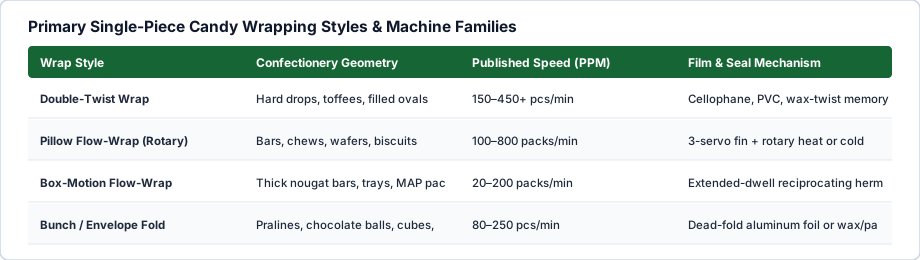
6-Step Candy Wrapper Selection Matrix
Match your confection parameters directly to wrapper hardware:
| Selection Step | Question to Answer | Resulting Hardware Choice |
|---|---|---|
| 1. Consumer Wrap Style | Twisted ends, sealed pillow, pleated foil, or square wallet? | Double-twist vs 3-servo HFFS vs foil bunch vs envelope fold |
| 2. Moisture Barrier Need | Temperate dry market vs humid export (<1% moisture pickup)? | Open twist wrap vs hermetic rotary/box-motion pillow pack |
| 3. Thermal Sensitivity | Boiled sugar (>100 °C safe) vs chocolate coating (<28 °C)? | Standard heat-seal jaws vs cold-seal cohesive + chilled bed |
| 4. Piece Shape Tolerance | Precision die-pressed (±0.5 mm) vs variable bar/slumped chew? | Rotary pocket disc vs optical 4-belt smart phasing infeed |
| 5. Upstream Feeding | Cooled batch bins vs live continuous enrober/rope sizer? | Bulk vibratory bowl vs automatic cross-row splitter or cut-and-wrap |
| 6. Fleet Availability | How many wrappers match kitchen kg/h at 85% availability? | Single head + auto-splicer vs N+1 modular wrapper legs |
Verify pre-shipment performance with our candy wrapper RFQ and FAT checklist.
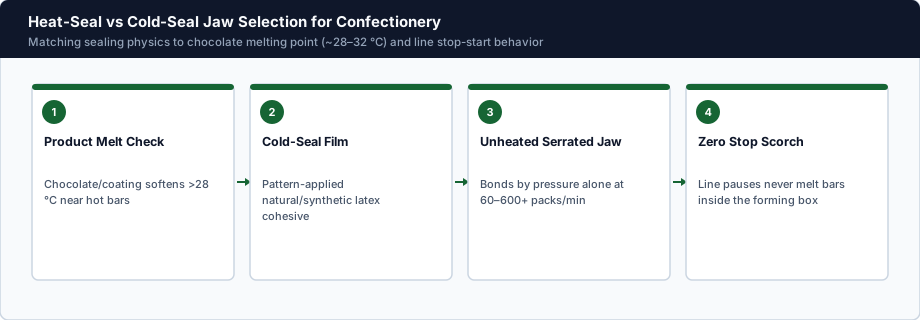
High-Speed Wrapping Engineering Notes
- Test Real Film Slip & Twist Retention: Film COF (coefficient of friction) over stainless formers and twist-retention angle must be proven at full speed, not hand-wrapped.
- Check Sanitary Crumb Clearance: Balcony-style frames keep drive belts isolated from sticky sugar dust and brittle wafer crumbs.
- Plan Changeover Frequency: If one line wraps three bar lengths daily, 3-servo electronic bag-length presets save hours over mechanical chain-pitch swaps.
Turn Your Six Answers Into a Crisp Brief
Share piece L × W × H, weight (g), kitchen kg/h, and preferred wrap style.
Send your specifications via our Project Brief.
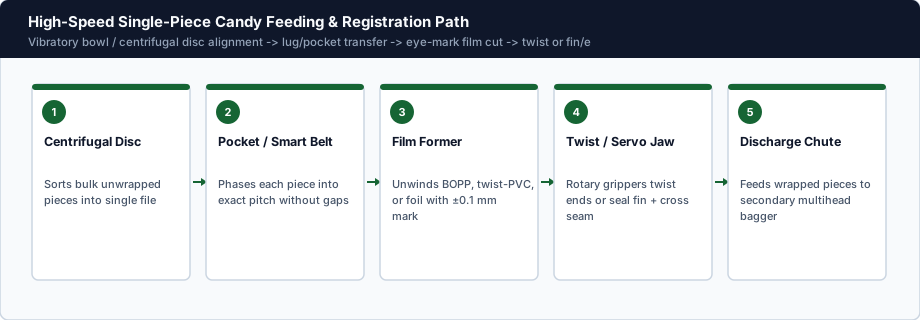
Explore related single-piece systems in Candy Wrapping Machines, Film & Sealing Specs, or submit your piece dimensions via Project Brief.
Related Specifications
Further Reference
Request Project Configuration Review
Share layout constraints, architectural drawings, or throughput targets with Candy Wrapping Machine Technical Group.
Discuss My Wrapper Specs