Prove High-Speed Registration, Seal Tightness & Zero-Piece Standby at FAT
A wrapper that cycles empty film smoothly at 400 PPM can still scuff candies or drift eye-marks once real sugar-dusted pieces and printed reels are loaded. Anchored in candy wrapper sizing and selection and candy wrapping film and sealing specs, ship 15–30 kg of real production candies and 2–3 printed film reels for pre-shipment FAT.
Run sustained 30-minute endurance blocks at contracted nominal PPM while measuring empty-wrap rate, broken-piece rate, and seal integrity.
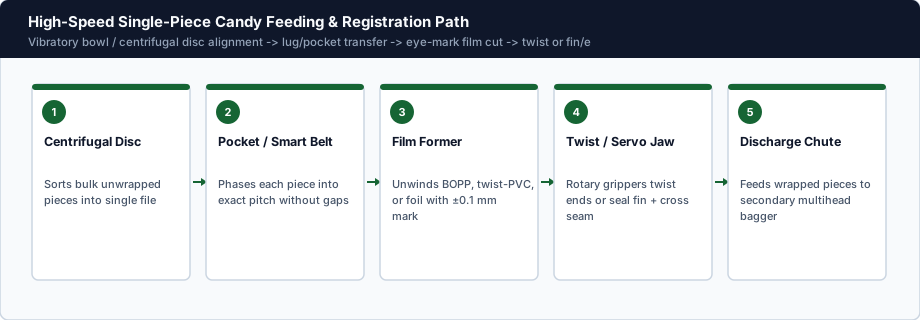
Single-Piece Wrapper FAT Qualification Protocol
Require documented pass/fail sign-off on all five test blocks:
| FAT Test Block | Test Procedure | Pass Acceptance Standard |
|---|---|---|
| 1. Sustained Speed & Feed | 30-min run at contracted nominal PPM on real candy | ≥98.5% net good wraps; <0.2% crushed/scuffed pieces |
| 2. Eye-Mark Registration | Measure print cutoff across 100 consecutive wraps | Within ±0.5–1.0 mm of artwork target window |
| 3. No-Candy / No-Paper Test | Intentionally starve infeed gaps at full speed | Zero empty sealed/twisted wrappers discharged |
| 4. Hermetic / Twist Audit | Vacuum water-bath (-0.06 MPa) on HFFS; shake test on twist | 100% leak-free pillow seals; <5% untwist after bulk drop |
| 5. Auto-Splice & Recipe Swap | Trigger reel splice at speed + recall second SKU length | Clean splice eject; format swap completed within target minutes |
See full tunnel-to-wrapper integration scope on candy wrapping line integration.
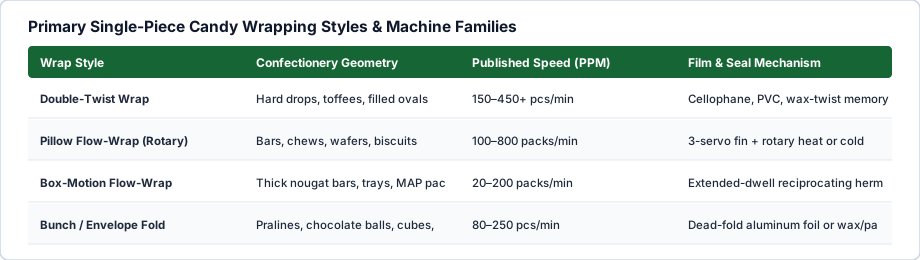
High-Speed Wrapping Engineering Notes
- Thermal Camera Check on Chocolate Runs: Verify bed-plate and jaw housing surface temperatures remain below 24 °C during sustained cold-seal chocolate tests.
- Archive Custom Pocket & Former Drawings: Keep CNC drawings and part numbers for every feed disc, folding box, and crimper anvil.
- Verify Wear Kit: Confirm spare rotary knives, twist grippers, heater cartridges, belts, and photoeyes are crated with the machine.
Ready to Issue Your Wrapper RFQ?
Send piece samples/drawings and film specs to receive an itemized engineering quotation.
Start your specification brief on Project Brief.
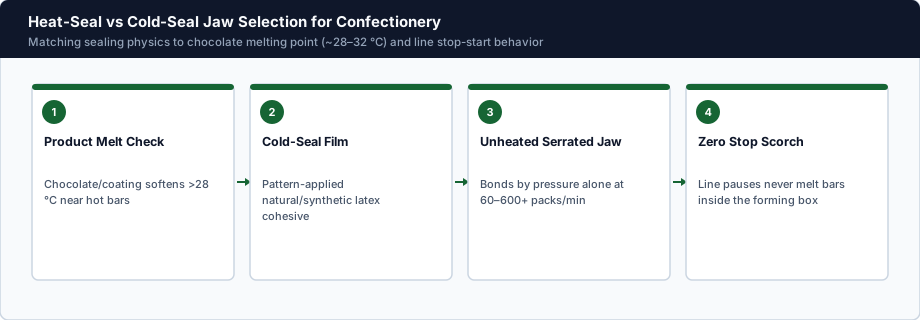
Explore related single-piece systems in Candy Wrapping Machines, Film & Sealing Specs, or submit your piece dimensions via Project Brief.
Related Specifications
Further Reference
Request Project Configuration Review
Share layout constraints, architectural drawings, or throughput targets with Candy Wrapping Machine Technical Group.
Discuss My Wrapper Specs