Where Capital Goes in Single-Piece Confectionery Wrapping
A manual-infeed 3-servo pillow wrapper and a fully automated cooling-tunnel-connected cold-seal chocolate leg differ by 3×–5× in scope—not because of the sealing head alone, but because of automatic row distribution, smart phasing belts, and flying film splicers. Inside candy wrapper sizing and selection and candy wrapping film and sealing specs, separating wrapper head capex from infeed automation clarifies payback.
Replacing 3–4 manual hand-feeders per shift while cutting damaged-bar scrap from 3% down to <0.3% typically recovers smart-infeed investment within 12–18 months.
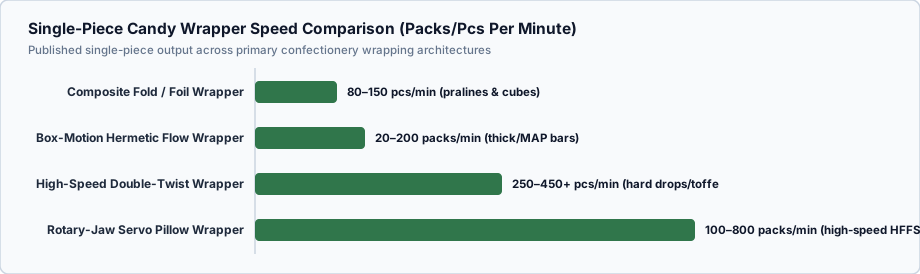
Candy Wrapper Tier & Option Cost Drivers
Compare scope and major cost drivers across the four primary wrapper classes:
| Equipment Class | Base Included Scope | Speed Class | Key Cost Adders |
|---|---|---|---|
| Standard 3-Servo Pillow HFFS (250/350) | Lug chain, adjustable/fixed former, eye-mark, HMI | 60–250 PPM | Cold-seal kit, water-chilled deck, TTO coder |
| High-Speed Mini Candy HFFS | Centrifugal disc feeder + multi-up rotary jaws | 300–800 PPM | Auto flying reel splicer, sound enclosure |
| Double-Twist / Lollipop Wrapper | Vibratory/disc bowl + rotary twist turret | 150–450+ PPM | Dual inner+outer web unwind, extra size discs |
| Box-Motion / Foil Fold Wrapper | Traveling hermetic head or brush-fold turret | 60–220 PPM | MAP gas analyzer, custom 3D mold plungers |
Size how many machines your kitchen needs on the output-to-wrapper calculator.
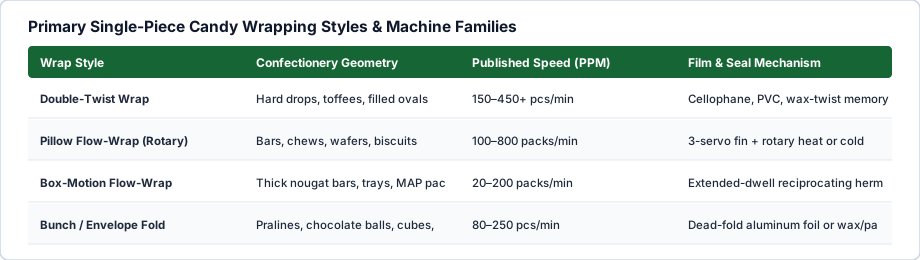
High-Speed Wrapping Engineering Notes
- Extra Size-Disc & Former Pricing: Ordering additional piece-size discs or fixed folding boxes during initial machine build saves custom retrofitting later.
- Film Splicer ROI Above 250 PPM: An automatic splicer adds modest capex while recovering 20–35 minutes of lost production per shift.
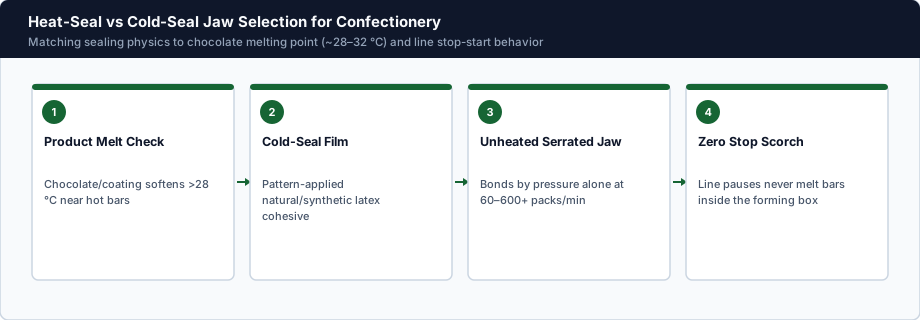
- Cold-Seal Film vs Chilled-Deck Math: Cold-seal cohesive film costs slightly more per kg than plain BOPP but unlocks 2×–3× higher chocolate wrapping speed with zero melt risk.
Request an Itemized Wrapper & Infeed Quote
Ask for itemized pricing on base wrapper, custom size tooling, automatic feeding, and 2-year wear parts.
Send your piece dimensions and target PPM via our Project Brief.
Explore related single-piece systems in Candy Wrapping Machines, Film & Sealing Specs, or submit your piece dimensions via Project Brief.
Related Specifications
Further Reference
Request Project Configuration Review
Share layout constraints, architectural drawings, or throughput targets with Candy Wrapping Machine Technical Group.
Discuss My Wrapper Specs