Preventing Fat Bloom, Scuff Marks, and Melted Smears
Cocoa butter crystals destabilize above 28–30 °C, meaning radiant heat from conventional 130 °C sealing rollers or friction from backed-up accumulation queues ruins chocolate gloss immediately. Inside confectionery wrapping applications and candy wrapping film and sealing specs, dedicated chocolate systems eliminate both thermal exposure and mechanical scuffing.
Countline chocolate bars and coated wafers run on 3-servo cold-seal horizontal flow wrappers (60–400+ PPM), while molded spheres, eggs, and luxury bars run on foil brush-fold or envelope inner-foil + outer-band machines.
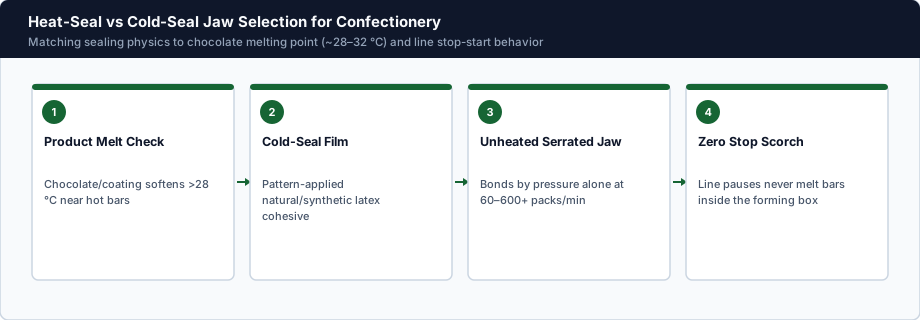
Chocolate Format to Wrapper & Thermal Protection Matrix
Verify thermal isolation and gentle feeding for each chocolate format:
| Chocolate Product | Preferred Wrapper | Sealing Method | Essential Chocolate Adaptation |
|---|---|---|---|
| Enrobed Countline & Nougat Bars | 350 Cold-Seal 3-Servo HFFS | Unheated serrated pressure jaws | 4-belt zero-pressure smart servo phasing |
| Molded Solid Tablet Bars (50–200g) | Envelope Foil + Band or Flow-Wrap | Inner dead-fold foil + glue paper band (or cold-seal) | Chilled deck + non-marking PU lugs |
| Filled Pralines & Truffle Spheres | Brush-Fold / Bunch Foil Wrapper | Mechanical brush/iris foil pleat | Plaque belt infeed + spring-damped plunger |
| Heat-Sealed Budget Compound Bars | 350 Heat-Seal HFFS (water-chilled) | Low-SIT BOPP + pneumatic jaw retract on stop | Glycol/water-cooled bed plates (<18 °C) |
Explore automated tunnel-to-wrapper row splitters on candy wrapping line integration.
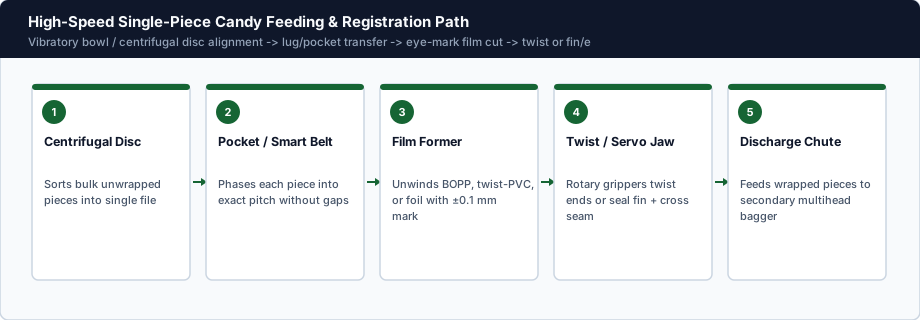
High-Speed Wrapping Engineering Notes
- Pneumatic Fin-Wheel Retraction: If using heat-seal film on compound coatings, specify automatic pneumatic fin-wheel retraction whenever the line pauses so bars sitting in the tube never melt.
- Remote Electrical Heat Dissipation: Mount servo drives and transformers away from the product zone so cabinet exhaust never warms the chocolate feed belt.
- Easy Belt Scraping & Washout: Quick-release crumb trays and belt scrapers capture brittle wafer/nut fragments before they imbed into subsequent bars.
Specify Incoming Bar Temp & Tunnel Width
Confirm chocolate core/surface exit temperature from the cooling tunnel (ideally 14–16 °C), bar L × W × H, and cold-seal vs foil artwork.
Request a chocolate wrapping configuration via our Project Brief.
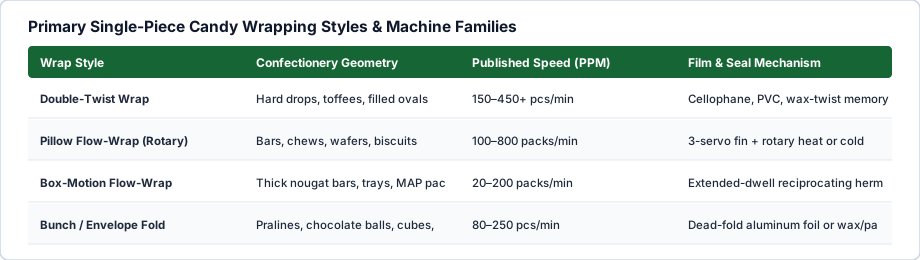
Explore related single-piece systems in Candy Wrapping Machines, Film & Sealing Specs, or submit your piece dimensions via Project Brief.
Related Specifications
Further Reference
Request Project Configuration Review
Share layout constraints, architectural drawings, or throughput targets with Candy Wrapping Machine Technical Group.
Discuss My Wrapper Specs