Film Memory and Seal Physics Govern High-Speed Uptime
Half of all shop-floor wrapping faults trace back to mismatched film mechanics: BOPP without twist-retention memory untwisting in the bag, hot jaws blooming chocolate coatings, or rotary end-jaws leaking on thick barrier laminates.
Compare product-specific setups in confectionery wrapping applications and calculate line counts in wrapper sizing and selection.
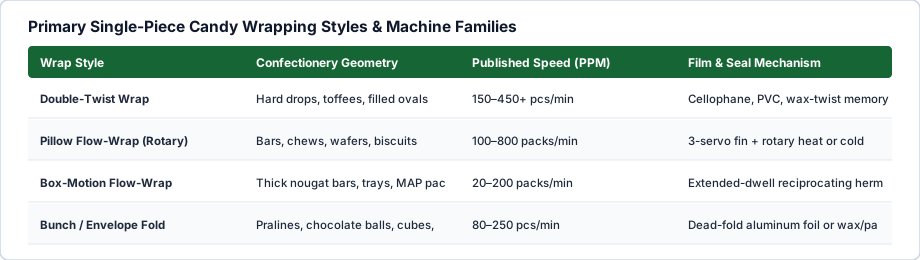
Confectionery Film & Sealing Method Matrix
Match your wrapping web to mechanical closure physics and shelf-life barrier requirements:
| Closure Mechanism | Required Film Property | Typical Web Thickness | Seal Integrity | Primary Confectionery Use |
|---|---|---|---|---|
| Mechanical Twist (No Heat) | High dead-fold / twist memory (<15° springback) | 22–32 μm Cellophane, PVC, twist-PET | Dust wrap (non-hermetic) | Hard drops, eclairs, throat sweets |
| Rotary Fin + End Heat Seal | Low seal-initiation temp (SIT 105–120 °C) | 25–50 μm BOPP / pearlized OPP / VMCPP | Standard pillow barrier | Individual candies, wafers, bars |
| Box-Motion Extended Dwell | Multi-layer PET/ALU/PE or MAP barrier | 45–80 μm barrier laminate | Hermetic (<1% O2 MAP) | Soft cakes, multi-packs, hygroscopic chews |
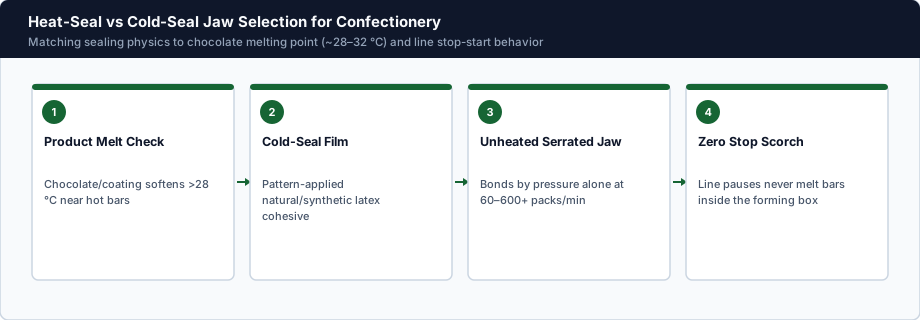
| Cold-Seal Pressure Cohesive | Pattern-coated latex on inner borders only | 30–55 μm metallized BOPP + release lacquer | Hermetic with zero heat | Enrobed chocolate bars, pralines, ice novelties |
Explore complete wrapper platforms in candy wrapping machines.
High-Speed Wrapping Engineering Notes
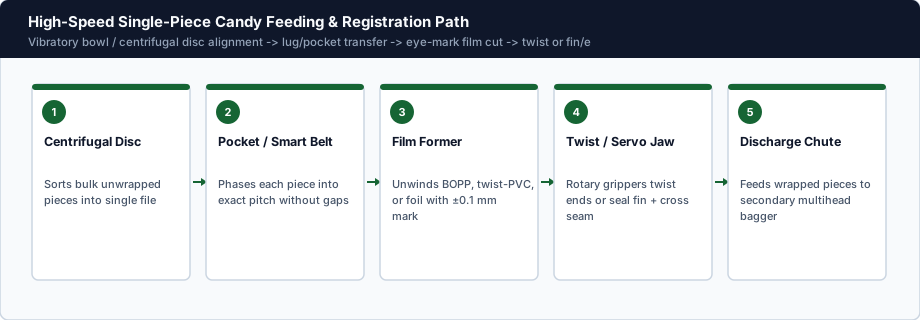
- ±0.1 mm Eye-Mark Registration: High-contrast photoelectric mark sensors adjust servo cutter phase each cycle so centered brand logos never drift across the candy face.
- Static Elimination on Twist Film: Ionizing bars along the unwind and rotary knife prevent lightweight 25 μm cellophane squares from clinging to brass twist grippers.
- Cooling-Tunnel Speed Synchronization: When wrapping directly off a chocolate enrober or starch mogul, smart multi-stage phasing belts absorb row-rate surges without manual handling.
Sample Film & Candy Compatibility Checks
Provide film roll core ID (76 mm standard), max reel OD (300–400 mm), eye-mark spacing, and coating melt temperature.
Confirm film and jaw specs via our Project Brief.
Explore related single-piece systems in Candy Wrapping Machines, Film & Sealing Specs, or submit your piece dimensions via Project Brief.
In This Section
Further Reference
Request Project Configuration Review
Share layout constraints, architectural drawings, or throughput targets with Candy Wrapping Machine Technical Group.
Discuss My Wrapper Specs